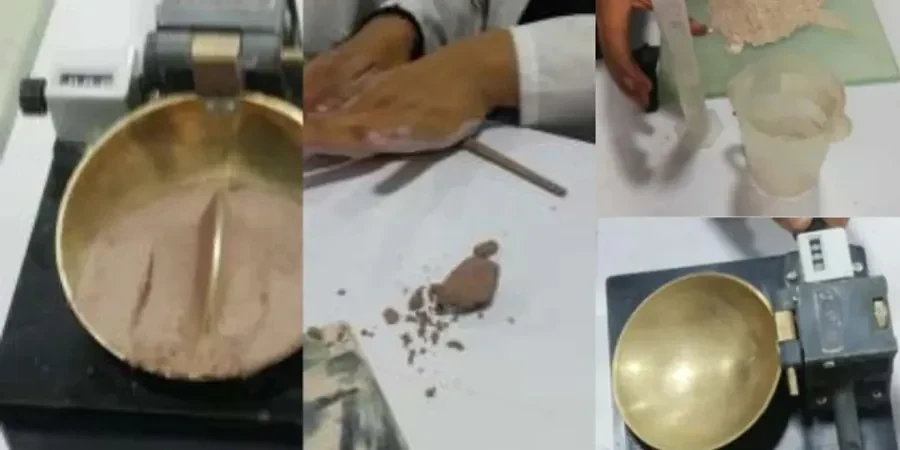
At roughly 54 metres above sea level, Newcastle upon Tyne sits on a complex glacial legacy that directly impacts foundation design. The city’s population of over 300,000 has driven extensive brownfield redevelopment along the Tyne corridor, where site investigation logs repeatedly encounter variable alluvial clays and laminated silts. Our Newcastle lab runs Atterberg limits testing to BS 1377-2:1990, using the Casagrande cup method for liquid limit and the 3 mm thread-rolling procedure for plastic limit. These two index values — combined into the plasticity index — classify fine-grained soils and flag shrink-swell potential before a single footing is poured. For deeper profiling across the Gateshead side, we pair the limits with CPT testing to correlate tip resistance with consistency index, giving the geotechnical engineer a continuous picture of the drift geology without relying solely on recovered samples.
A plasticity index above 20 % in Newcastle’s alluvial clays typically signals medium-to-high shrink-swell potential — a critical parameter for shallow footing design under BS 8004.
Scope of work in Newcastle
Critical ground factors in Newcastle
A 7-storey residential block on the Quayside hit an unexpected 2.8 m lens of soft grey clay at 4.5 m depth — the borehole log from the preliminary desk study had classified it as medium-dense sand. When the samples reached our lab, the liquid limit came back at 62 %, the plastic limit at 24 %, giving a plasticity index of 38 %. That single result triggered a design change from strip footings to CFA piles socketed into the underlying glacial till. Without the Atterberg limits, the project would have proceeded on a soil description alone — and a description won’t tell you how much water the clay can hold before it flows. In Newcastle’s post-industrial river terraces, where historical fill masks the natural sequence, skipping the limits is a gamble no geotechnical engineer should take. We also run the methylene blue test when smectite presence is suspected, because a PI above 30 % in Tyne Valley clays often correlates with montmorillonite-rich horizons that swell with even minor moisture changes.
Our services
Our Newcastle geotechnical laboratory delivers Atterberg limits testing as part of a wider classification suite. Every result is peer-reviewed by a chartered engineer familiar with North East drift geology.
Liquid Limit (Casagrande)
Four-point or one-point method per BS 1377-2. Penetrometer fallback cone method available for very soft clays where the cup closure is ambiguous.
Plastic Limit & Plasticity Index
Thread-rolling by experienced technicians. PI reported alongside liquidity index when natural moisture content is supplied.
Linear Shrinkage
BS 1377-2:1990, clause 5. Recommended for high-plasticity clays when PI alone does not fully characterise volume change potential.
Methylene Blue Absorption
Supplementary test for suspected smectite. Quantifies specific surface area and cation exchange capacity of the clay fraction.
Q&A
What is the difference between a one-point and a four-point liquid limit test?
The four-point test determines liquid limit from a flow curve plotted using four moisture-content readings at varying blow counts. It is the reference method under BS 1377-2 and is required for design-phase reporting. The one-point method uses a single moisture-content determination and a correction factor; it is faster and suitable for earthworks control or preliminary classification where the material type is already known. Our lab always notes which method was used on the test certificate.
How much does Atterberg limits testing cost for a Newcastle project?
A standard pair of liquid limit and plastic limit tests ranges from £40 to £80 per sample, depending on whether a one-point or four-point LL is requested, and whether linear shrinkage or methylene blue is added. Larger batch volumes attract reduced per-sample pricing. Same-day express service carries a surcharge.
Can you test samples from sites outside Newcastle, such as Northumberland or Durham?
Yes. We receive disturbed and undisturbed samples from across the North East, including Northumberland, County Durham, Teesside, and North Yorkshire. Samples are logged on arrival, stored in humidity-controlled cabinets, and processed to the same BS 1377-2 standard regardless of origin. We can arrange courier collection for larger site investigation campaigns.