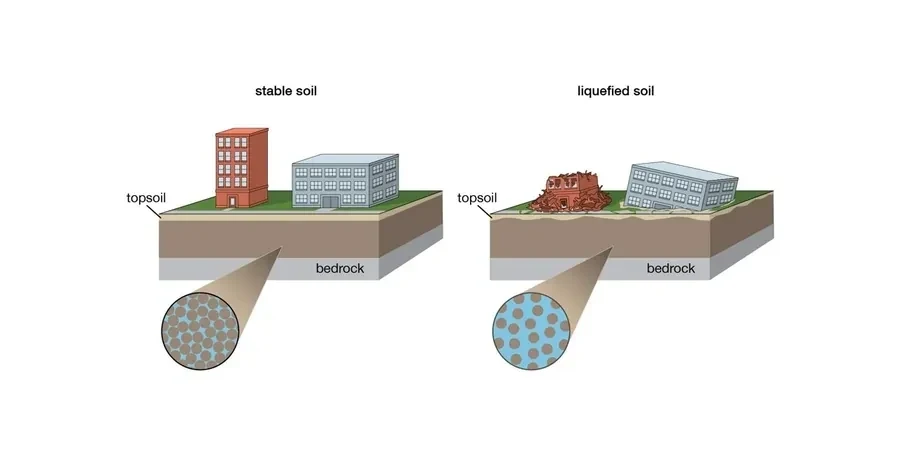
Newcastle sits just 46 metres above sea level on the north bank of the Tyne, and while major seismic events are rare in the UK, the city’s industrial legacy and riverine geology demand a careful look at ground behaviour. The Coal Measures bedrock is often buried beneath layers of alluvial sand, silt, and made ground — materials that can lose strength under cyclic loading. That is exactly where a soil liquefaction analysis comes in. We run the assessment following BS 5930 and Eurocode 7 (BS EN 1997-1:2004) to check whether saturated granular soils on your site could turn to slurry during vibration. For projects near the Quayside or in redeveloped brownfield plots, combining this with test pits gives us a direct view of the strata before any intrusive work begins. The goal is straightforward: give you a clear picture of risk so foundation decisions are grounded in data, not guesswork.
In Newcastle, the main liquefaction concern is not large-magnitude quakes but loose saturated sands in former river channels reacting to long-duration vibration.
Scope of work in Newcastle
Critical ground factors in Newcastle
The rig we bring to Newcastle sites is a compact tracked CPT unit that can access tight brownfield plots without tearing up the access road. It pushes a cone at 2 cm per second while measuring tip resistance, sleeve friction, and pore pressure — all in real time. In loose sands, the data shows a sharp drop in cone resistance and a spike in pore pressure, both classic signatures of a layer that could liquefy. If access is too tight for the tracked rig, we switch to a portable SPT setup with an automatic hammer to keep energy consistent. In either case, the equipment is calibrated to BS EN ISO 22476-1 for CPT and BS EN ISO 22476-3 for SPT. The key is repeatability: two tests in the same sand lens should give the same answer within a few percent, or we run a third to settle the discrepancy.
Our services
Our liquefaction work in Newcastle covers two main packages. Pick the one that fits your project stage, or start with the screening and add the full analysis if the data flags a risk.
Liquefaction Screening Report
Desktop review of existing borehole logs and groundwater data against the screening criteria in BS 5930. We flag whether a full analysis is required based on soil type, depth to water, and site seismicity. Turnaround is typically five working days.
Full Site-Specific Liquefaction Analysis
Field investigation plus laboratory testing (grain size, Atterberg limits) followed by cyclic stress evaluation per Youd-Idriss or Robertson methods. Output includes factor of safety profiles, liquefaction potential index, and estimated ground settlement for your design team.
Q&A
How much does a soil liquefaction analysis cost for a Newcastle site?
For a typical single-structure plot in Newcastle, budget between £2,250 and £3,080 for a full analysis including fieldwork, lab testing, and the engineering report. The final figure depends on borehole depth, number of test locations, and whether we use CPT or SPT.
Do I even need a liquefaction analysis in Newcastle when the UK is not very seismic?
The UK has low-to-moderate seismicity, but Eurocode 7 still requires a liquefaction check when the groundwater table is high and granular soils are present. In Newcastle, many riverside and brownfield sites fall into this category, so the analysis is often a planning condition or a structural engineering requirement.
What is the difference between a screening and a full liquefaction analysis?
Screening is a desk-based check using existing logs and groundwater records to see if the site meets the criteria for potential liquefaction. If it does, the full analysis adds field testing, lab work, and numerical modelling to give you a factor of safety and settlement estimate for each soil layer. Screening saves time and cost when the risk is clearly low from the outset.