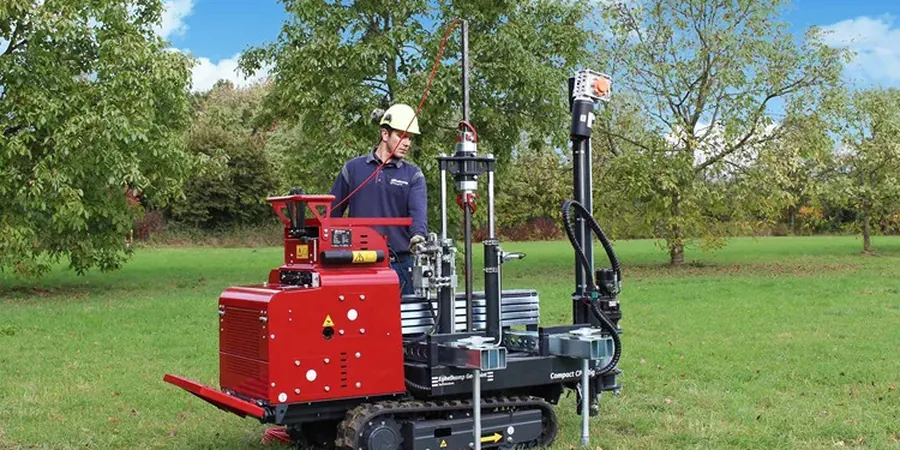
A recent residential development on the sloping terrain near Jesmond Dene required accurate soil profiling before foundation design could proceed. The developer had initial site investigation data from trial pits, but the variable depth of glacial till overlying the Pennine Coal Measures demanded continuous stratigraphic information. Our technical team deployed a 20-tonne CPT rig to push through the stiff upper layers and reach the competent sandstone bedrock at roughly 12 metres depth. The cone penetration test delivered a near-continuous profile of tip resistance, sleeve friction, and dynamic pore pressure that allowed the structural engineer to identify three distinct bearing strata and avoid an expensive over-excavation into the weathered coal seam. In Newcastle, where the geology shifts from river terrace gravels along the Tyne to dense boulder clay on the higher ground, CPT testing provides a level of stratigraphic resolution that traditional boreholes simply cannot match on their own. We often pair the cone penetration data with a triaxial compression suite to derive effective strength parameters for the cohesive layers encountered during the push.
A single CPT sounding in Newcastle can replace three to four SPT boreholes for stratigraphic profiling, cutting site investigation time by half while delivering continuous digital records.
Scope of work in Newcastle
Critical ground factors in Newcastle
Newcastle sits roughly 54 metres above sea level at its highest points, descending to near zero at the Quayside, and the post-glacial soft alluvium along the Tyne corridor can exceed 8 metres in thickness in places like Walker and Byker. Omitting cone penetration testing in these areas and relying solely on disturbed samples from light cable percussion rigs misses the subtle pore pressure response that signals contractive, potentially liquefiable silts. The city's mining heritage adds another layer of complexity: unrecorded shallow workings and bell pits in the High Main and Bensham seams create abrupt voids or collapsed zones that a CPT push will encounter as a sudden loss of tip resistance followed by a rod drop, a signature no other method captures in real time. Our team has traced the edge of a backfilled quarry near Heaton using a grid of CPT soundings spaced at 15-metre centres, mapping the transition from natural dense sand to uncontrolled fill in a single afternoon. The cone penetration test, executed under BS EN ISO 22476-1, delivers the continuous mechanical response needed to design safe foundations in this layered urban geology.
Our services
Our Newcastle CPT service covers the full investigation cycle from site access planning to final geotechnical interpretative report. Every cone is calibrated before and after the field campaign, and dissipation tests follow a site-specific programme designed around the expected soil profile.
Seismic CPT (SCPTu)
Measures shear wave velocity (Vs) every 0.5 m during the push, providing direct dynamic soil properties for seismic site classification and liquefaction screening in Tyne Valley alluvium.
Piezocone dissipation testing
Monitors pore pressure decay at selected depths to estimate consolidation characteristics and in-situ permeability of cohesive soils, critical for settlement predictions in Newcastle's glacial lake deposits.
CPT-based pile design
Direct application of tip resistance and sleeve friction profiles to calculate axial pile capacity using LCPC, Eslami-Fellenius, and ICP-05 methods, avoiding conservative SPT-based correlations.
Q&A
How much does CPT testing cost in Newcastle?
For a standard 20-tonne piezocone push in the Newcastle area, you can expect to budget between £120 and £180 per linear metre. The final figure depends on the target depth, the number of dissipation tests required, and whether you need the seismic module for Vs measurements. Mobilisation within the city is typically included for campaigns exceeding 50 linear metres.
What depth can the CPT rig reach in the glacial till around Gosforth?
The stiff boulder clay around Gosforth and Jesmond can generate cone resistances exceeding 15 MPa. Our 20-tonne rig routinely reaches 15 to 18 metres in these conditions. For deeper pushes or when the till contains large cobbles at the base, we deploy a 32-tonne unit capable of penetrating to 25 metres. Pre-drilling through the upper metre of fill is sometimes necessary.
Can CPT data distinguish between natural sand and mine backfill in Newcastle?
Yes, and this is one of the most valuable applications in the city. Natural dense sand shows a consistent, gradually increasing tip resistance with depth. Uncontrolled mine backfill or collapsed workings produce erratic sleeve friction ratios, negative pore pressure spikes, and sudden drops in qc. The continuous digital record from a CPT push makes these transitions far clearer than SPT N-values at 1.5-metre intervals.
How long does a CPT site investigation take in Newcastle?
A single push to 15 metres, including dissipation tests at two or three depths, typically takes 45 to 90 minutes of penetration time. With rig setup, calibration checks, and demobilisation, you can expect a crew on site for half a day per three to four soundings. Data processing and the geotechnical interpretative report are usually delivered within five working days of the field campaign.