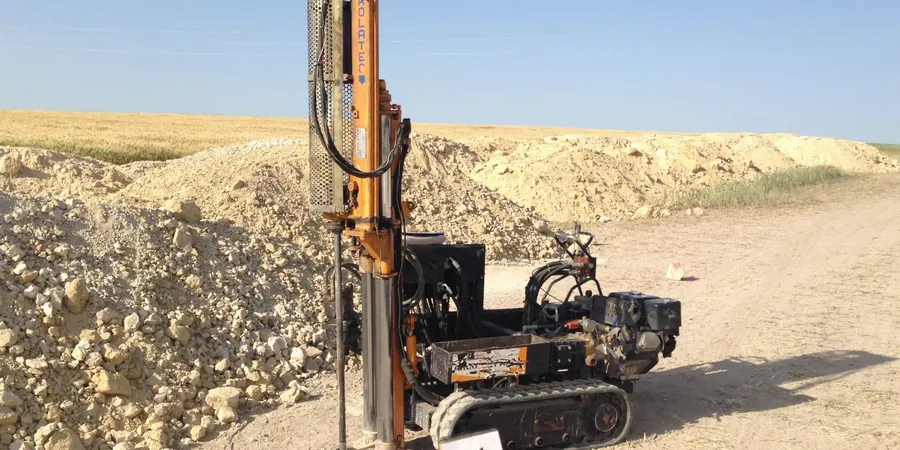
Newcastle’s geology shifts abruptly between the dense boulder clay of the Team Valley and the jointed sandstone beneath the city centre. A site in Gosforth can drain completely differently from one in Sandyford, even when both sit above the Pennine Middle Coal Measures. We run field permeability tests—Lefranc falling-head tests in overburden and Lugeon packer tests in rock—to measure hydraulic conductivity where it matters. Standard lab tests on small samples miss fissure flow entirely. On a recent student accommodation excavation near Manors, the difference between tested mass permeability and initial desk-study assumptions changed the dewatering specification by a factor of four. The test pits crew logged glacial till depth while our driller ran Lefranc tests at multiple horizons, giving the contractor a layered conductivity profile they could price against. With 54.97°N latitude and average rainfall exceeding 800 mm per year, groundwater is a constant project constraint in Newcastle.
A single Lugeon test in fractured Fell Sandstone often reveals conductivity twenty times higher than intact core samples predict.
Scope of work in Newcastle
Critical ground factors in Newcastle
The Lugeon packer assembly runs downhole on drill rods—a single or double inflatable packer isolating a test section between rubber glands rated to 20 bar. In fractured Newcastle sandstone the packer seal can fail if the borehole wall is rugose, so we ream the test interval with a diamond bit before setting the tool. A constant-head system feeds water from a calibrated flow meter on surface; pressure transducers record at the packer and at the gauge board. The main risk is hydrofracturing—overpressuring rock until joints open permanently—which gives falsely high Lugeon values and can damage the formation. We follow the Houlsby criterion: maximum test pressure must stay below overburden stress to avoid fracture extension. A slope stability assessment for a retaining wall near the Quayside incorporated our permeability data directly, confirming that drawdown behind the wall would not trigger rapid settlement in the overlying made ground.
Our services
We run three tiers of in situ permeability testing across the North East, all executed by drillers with CSCS and NVQ certification and supervised by a chartered engineering geologist.
Lefranc borehole tests in overburden
Falling-head and constant-head tests in glacial till, alluvium, and colluvium. We isolate 300–500 mm intervals behind a pneumatic packer and log the recovery curve with a pressure transducer. Data delivers hydraulic conductivity (k) values for dewatering well design and cut-off wall specification.
Lugeon packer tests in rock
Five-stage pressure tests in sandstone and limestone using single or double packer assemblies. We interpret Lugeon values against Houlsby and Ewert criteria, flagging fracture flow, dilation, and wash-out behaviour. Essential for shaft sinking and tunnel inflow prediction in the Pennine Coal Measures.
Combined permeability and pumping test programmes
Integrated site investigation: borehole permeability testing plus CPT logging in soft alluvium and monitoring well installation. We correlate in situ k values with grain-size distributions and SPT results, building a layered groundwater model for contractors tendering Newcastle basement excavations.
Q&A
What does a field permeability test cost in Newcastle?
A single Lefranc or Lugeon test in a borehole typically ranges from £430 to £910, depending on depth, number of test intervals, and whether a drilling rig is already on site. Mobilising a rig solely for permeability testing adds a separate mobilisation charge. We offer fixed-price quotes after reviewing the site location and ground conditions.
When should I specify a Lugeon test instead of a Lefranc test?
Use the Lefranc method in soil—glacial till, alluvium, made ground—where the test section can be isolated within a single stratum. Specify a Lugeon packer test when drilling into rock, particularly fractured sandstone or limestone where secondary permeability from joints dominates flow. The five-stage Lugeon procedure reveals whether fractures dilate or clog under pressure, which a single-stage Lefranc test cannot detect.
How long does a permeability test take on a Newcastle site?
A single Lefranc rising- or falling-head test takes 20 to 40 minutes once the borehole is advanced and the test interval prepared. A full five-stage Lugeon test runs 45 to 90 minutes per interval, including packer inflation, pressure stabilisation, and stage transitions. We can run multiple tests in one shift if the driller advances the hole efficiently.
Which Newcastle geology typically gives the highest Lugeon values?
The Fell Sandstone Formation, which outcrops in the Ouseburn valley and dips beneath the city centre, often yields Lugeon values above 10 Lu in the upper 15 metres where jointing is open. Weathered zones at the sandstone–till interface can produce even higher readings. By contrast, the Pennine Middle Coal Measures mudstone and siltstone intervals frequently test below 1 Lu unless faulted.
Do you provide test data in formats suitable for Plaxis or SEEP/W modelling?
Yes. We deliver hydraulic conductivity (k) values for each test interval in Excel and PDF formats, with test curves, pressure records, and interpretation notes. The data is structured so a geotechnical modeller can assign layer-specific permeability directly to a Plaxis or SEEP/W mesh. We also supply borehole logs with packer positions and water strike depths.