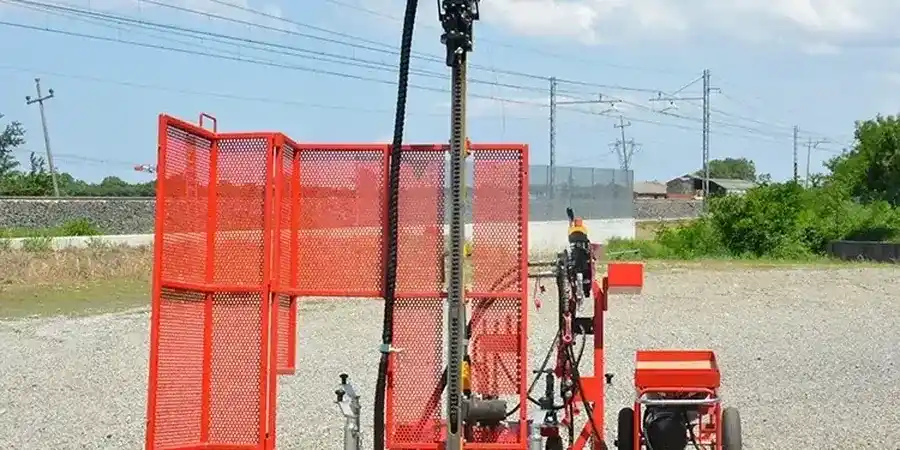
A warehouse redevelopment down by the Ouseburn culvert last autumn ran into something we see all the time in Newcastle — three metres of made ground over a stony, variable glacial till, and the structural engineer needed bearing numbers fast. You can't guess that from a trial pit alone, not when the lower layers are water-charged and the site sits close to a buried dene. We mobilised the rig inside a week, ran a Standard Penetration Test programme to 12 metres across five locations, and the N-values told the story: loose fill dropping to refusal on a mudstone head at depth. For sites across Tyneside, the SPT remains the most practical way to get depth-specific strength data without sending every sample to the lab first. We often pair it with CPT sounding when the strata are soft enough to push, but in glacial tills the hammer and split spoon still give us the clearest picture.
In Newcastle's glacial tills, N60 values above 25 generally indicate a stratum suitable for shallow foundations, but always verify lateral continuity across the footprint.
Scope of work in Newcastle
Critical ground factors in Newcastle
Eurocode 7 (BS EN 1997-2:2007) is unambiguous: you must characterise the ground to a depth where the stress increase becomes negligible. In Newcastle, skip the SPT on a sloping site above the Tyne valley and you risk missing a thin, soft clay seam within the glacial sequence — the kind of layer that governs slope stability and differential settlement. We've seen it on a school extension in Benwell where a buried alluvial lens, undetected by earlier window sampling, showed N-values of 3 and triggered a redesign to piled foundations. The Coal Authority's shallow workings database adds another layer of caution; refusal or rod drop during SPT can be the first clue of an uncharted mine entry. The test is not just about bearing capacity — it is your first line of defence against ground hazards that are well-documented across the North East coalfield.
Our services
Our Newcastle SPT programme is designed to give you a complete set of field parameters without slowing the site programme. Every job includes calibrated hammer energy measurement, detailed logging by an engineering geologist familiar with the local geology, and a factual report that ties N-values to the BGS 1:10,000 map units for the Tyneside area. The two core packages below cover most ground investigation briefs we receive from structural engineers and architects in the region.
SPT with Rotary Drilling and Laboratory Testing
For projects requiring foundation design parameters, we combine SPT at 1.5 m intervals with rotary open-hole drilling through the Coal Measures. Samples are taken to our UKAS-accredited laboratory for triaxial, Atterberg limits, and sulphate testing to BRE SD1. The factual report includes N60, (N1)60, soil descriptions to BS 5930, and preliminary bearing capacity estimates.
SPT for Seismic Site Classification and Liquefaction Assessment
Where Part A of the Building Regulations requires a seismic class (Newcastle lies in a low-to-moderate seismicity zone with amplification possible on soft alluvium), we run SPT with energy-calibrated hammer and derive Vs proxies. The report plots N-value profiles against depth, assigns NEHRP site class, and, where saturated silts are encountered, runs a simplified liquefaction triggering analysis per Youd & Idriss (2001).
Q&A
What does an SPT test cost in Newcastle?
For a typical investigation with three to five boreholes to 12 metres depth, an SPT programme in the Newcastle area runs between £380 and £620 per borehole, depending on access, traffic management, and whether we use a tracked rig or a restricted-access unit. The price includes calibrated hammer energy measurement, logging by an engineering geologist, and the factual report with N60 and (N1)60 values. Mobilisation, laboratory testing, and interpretive reporting are quoted separately based on the brief.
How deep do you normally test for a two-storey residential extension?
For a lightly loaded residential extension, we typically drill to 6-8 metres below ground level or until we encounter competent natural strata with N60 values above 20. On the boulder clay that blankets much of Newcastle, refusal often occurs between 3 and 5 metres, but we always extend the borehole at least 2 metres into the competent layer to confirm it is not a boulder. The exact depth is governed by the zone of influence of the foundation, calculated per Eurocode 7.
How long does it take to get the SPT results?
Fieldwork for a standard three-borehole programme in Newcastle is usually completed in one day. The factual report, including borehole logs, N-value plots, and soil descriptions, is delivered within five working days. If laboratory testing is required — for example, sulphate content or triaxial strength — the full interpretive report may take an additional two weeks, depending on curing times for the specimens.
Can you test through the Coal Measures sandstone with SPT?
The split spoon sampler is designed for soil and very weak rock. Once we encounter competent sandstone of the Pennine Middle Coal Measures, which commonly has an unconfined compressive strength exceeding 5 MPa, the SPT is halted and we switch to rotary coring to recover a rock core. The driller's log will record the depth of refusal and the nature of the contact, which is critical information for pile design in Newcastle, where rockhead can be highly irregular.
Do I need an SPT if I already have trial pits on site?
Trial pits give you a visual profile to 3-4 metres, which is useful for near-surface characterisation, but they cannot offer quantitative strength data or penetrate below the water table. In Newcastle, where glacial till often extends well below 4 metres and groundwater is perched in the overlying made ground, the SPT is necessary to obtain N-values for bearing capacity calculation and to sample deeper strata for laboratory testing. The two methods are complementary, not interchangeable.