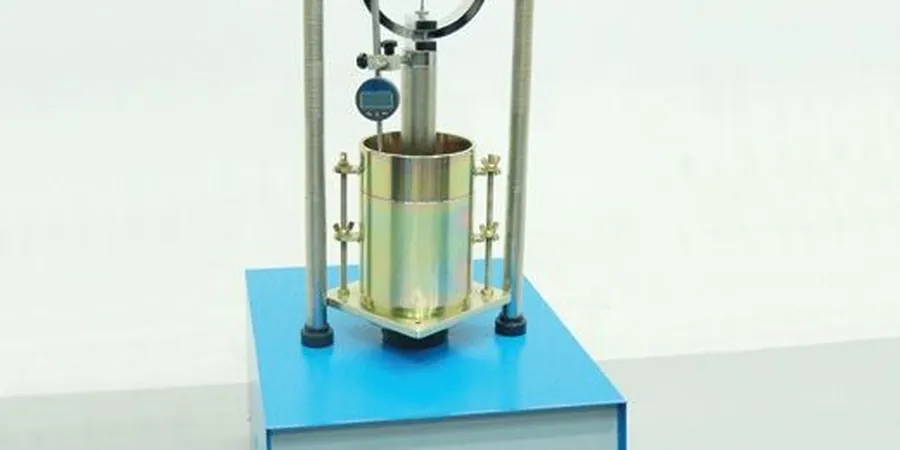
The loading press applies force at a steady 1.27 mm per minute, and the proving ring starts to register resistance almost immediately. That is the moment a laboratory CBR test in Newcastle reveals whether the subgrade will hold up under traffic. Our team runs these tests inside a temperature-controlled lab, using remoulded samples compacted to the moisture and density conditions specified by the project’s earthworks specification. Newcastle’s geology shifts dramatically across the city—from the boulder clay of the Team Valley to the sandstone bedrock near the city centre—so a single assumed CBR value never tells the full story. We often pair the laboratory CBR with a Proctor test to lock in the compaction target before any soaked or unsoaked penetration runs begin, ensuring the result reflects what the site crew will actually achieve.
A CBR value of 2% versus 5% can double the required pavement thickness—getting that number right in the lab saves metres of stone on site.
Scope of work in Newcastle
Procedure video
Critical ground factors in Newcastle
In Newcastle, we see one pattern repeat itself on road reconstruction jobs: the site investigation logs a stiff boulder clay at 3 metres, the design assumes CBR 5%, and then a wet autumn hits during earthworks and the exposed formation turns to slurry within hours. A laboratory CBR test performed only on unsoaked samples will miss that sensitivity entirely. When the DMRB requires a soaked CBR for cohesive subgrades, skipping that step means the pavement ends up under-designed for the worst-case groundwater condition. The cost of a failed pavement on a bus lane along Westgate Road or a logistics yard in Blaydon is orders of magnitude higher than the lab programme that would have flagged the problem during design. We always ask whether the formation will be trafficked during construction, because remoulding under site plant can knock the in-situ CBR down to half the lab value.
Our services
Our Newcastle laboratory runs CBR programmes for projects ranging from residential estate roads to heavy-duty industrial pavements. Each test package is tailored to the formation type and the design traffic loading.
Soaked CBR for Cohesive Subgrades
Four-day soak under surcharge, with swell measurement and penetration testing, for glacial till and clay formations common across Tyneside.
Unsoaked CBR for Granular Capping and Sub-base
Immediate penetration testing on compacted granular materials to verify compliance with Series 800 earthworks specifications.
Q&A
How much does a laboratory CBR test cost in Newcastle?
A single-point laboratory CBR test typically costs between £80 and £160, depending on whether soaking is required and how many compaction points are included in the programme. We offer a fixed-price quote once we have the project specification and the material type.
What is the difference between soaked and unsoaked CBR?
An unsoaked CBR measures the strength of the material at its as-compacted moisture content, while a soaked CBR involves submerging the specimen in water for four days under a surcharge load before testing. The soaked value represents the worst-case condition when the water table rises or surface water infiltrates the pavement foundation, and DMRB CD 225 requires soaked values for cohesive subgrades.
How many CBR specimens do I need for a road design in Newcastle?
The number depends on the variability of the subgrade. For a uniform formation across a residential estate, three specimens per material type are often sufficient. On brownfield sites with mixed fill, we recommend a minimum of five specimens to capture the range of conditions and to derive a statistically reliable design CBR.
Can you test site-won material for re-use as capping?
Yes, we regularly test site-won material for earthworks compliance. The material is compacted in the lab at the target moisture content and density, and the resulting CBR value is used to confirm whether it meets the Series 800 threshold for Class 6 or Class 9 capping.