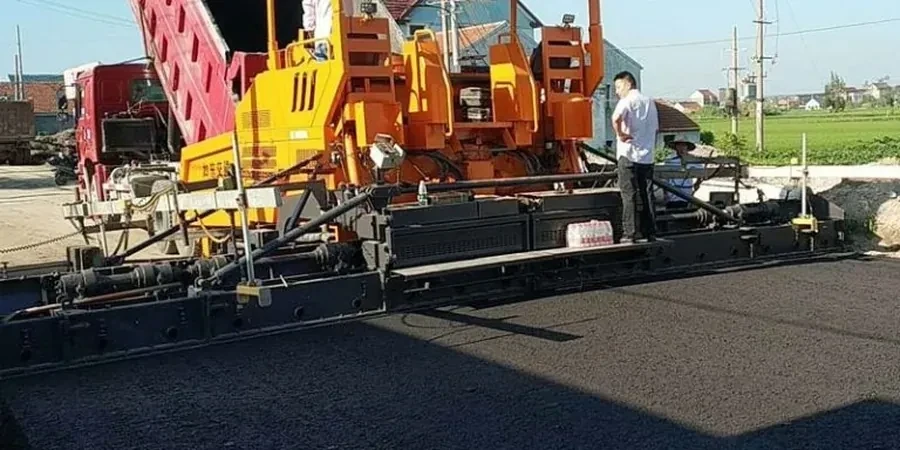
The asphalt paver’s screed levels the blacktop over a pre-compacted granular base, while a Bomag roller follows in tight echelon to lock the aggregate interlock before the mat cools. In a city where winter road temperatures routinely drop below 2 °C and the underlying geology shifts from glacial till in Gosforth to coal measure mudstones along the Tyne Valley, the pavement layers above have to handle thermal contraction and heavy bus loads without cracking. Our flexible pavement design for Newcastle roads, industrial yards, and residential access ways starts with a subgrade assessment that measures in-situ CBR, then builds the capping, sub-base, and bituminous binder course thicknesses around the predicted commercial vehicle traffic. The output is a construction-ready package that respects both the UK Design Manual for Roads and Bridges and the specific drainage demands of a maritime climate with 650 mm of annual rainfall.
A well-designed flexible pavement distributes wheel loads so the vertical stress at the subgrade level stays below 20 % of the soil's bearing capacity — the difference between a road that lasts 20 years and one that ruts in five.
Scope of work in Newcastle
Our approach also accounts for the high proportion of articulated buses on routes like the A186 and the frequent start-stop loading near the Central Station taxi ranks. Where the natural subgrade CBR falls below 2.5 %, we specify a stabilised capping layer with lime or cement to provide a working platform for the paving train. The final design includes a detailed layer schedule, material specifications, and compaction targets for each lift.
Critical ground factors in Newcastle
Many pavement failures we see in Newcastle start at the subgrade — not in the asphalt. When a car park on the former Elswick industrial estate develops alligator cracking within three years, the root cause is almost always water trapped in a poorly drained capping layer. The rainfall pattern here delivers persistent, low-intensity wetting that saturates the formation over months, softening the subgrade until the bound layers fatigue under normal traffic.
Skipping a proper CBR investigation means guessing the formation stiffness, and guessing leads to either over-design (unnecessary cost) or under-design (early structural failure). We also factor in the effect of buried activities — common in city-centre streets like Grainger Street — where trench reinstatement creates differential stiffness zones that concentrate strain at the pavement joints. A thorough flexible pavement design addresses these risks with drainage details, transition slabs, and material specifications that hold their strength when saturated.
Our services
Our Newcastle flexible pavement design package covers the full chain from site investigation to construction support. We work with local ground investigation crews and asphalt suppliers to keep the specification practical.
Traffic-Based Structural Design
We calculate the cumulative standard axle loading for the design life and derive the required layer thicknesses using multi-layer elastic analysis. The output is a set of cross-section drawings and a technical note suitable for planning or Section 278 submission.
Subgrade Assessment & CBR Improvement
On-site dynamic cone penetrometer testing and laboratory soaked CBR tests determine the formation strength. Where the CBR is marginal, we design a lime- or cement-stabilised capping layer with a mixing ratio and depth tailored to the Newcastle geology.
Q&A
How much does a flexible pavement design for a typical Newcastle access road cost?
For a residential access road or small car park in the Newcastle area, the design package typically ranges from £1,320 to £3,680 depending on the number of cross-sections, the extent of subgrade testing required, and whether the scheme needs a drainage addendum for local authority approval.
What subgrade CBR value is acceptable for a flexible pavement in the North East?
The DMRB sets a minimum formation CBR of 2.5 % for flexible pavements, but in practice we target a stabilised capping CBR of at least 15 % on Newcastle's glacial till. If the natural ground falls below that threshold, we specify a cement-bound capping layer to create a reliable working platform before the granular sub-base goes in.
Do you consider the frost susceptibility of Newcastle soils in the design?
Yes. The frost index for Tyne and Wear drives the minimum sub-base thickness in our designs. We classify the subgrade soil by its plasticity and grading, then apply the DMRB frost design method to ensure the combined capping and sub-base layers prevent ice lens formation beneath the bound courses. More info.