Newcastle's industrial legacy left more than just its seven iconic bridges. Beneath the Victorian terraces and modern Quayside developments, the ground tells a complex story of glacial till, alluvial silts along the River Tyne, and weathered Coal Measures mudstone. Designing a shallow foundation here means reading that story correctly. Foundation performance depends on understanding how these deposits interact with structural loads, particularly where historic mine workings and variable fill materials create abrupt transitions in bearing capacity over just a few metres. Our team applies in-situ permeability testing where groundwater fluctuations near the riverbank influence effective stress, and we correlate findings with grain-size distributions to refine settlement predictions under serviceability limit states.
Bearing capacity is only half the equation — in Newcastle's glacial till, differential settlement between adjacent footings often governs the final design.
Scope of work in Newcastle
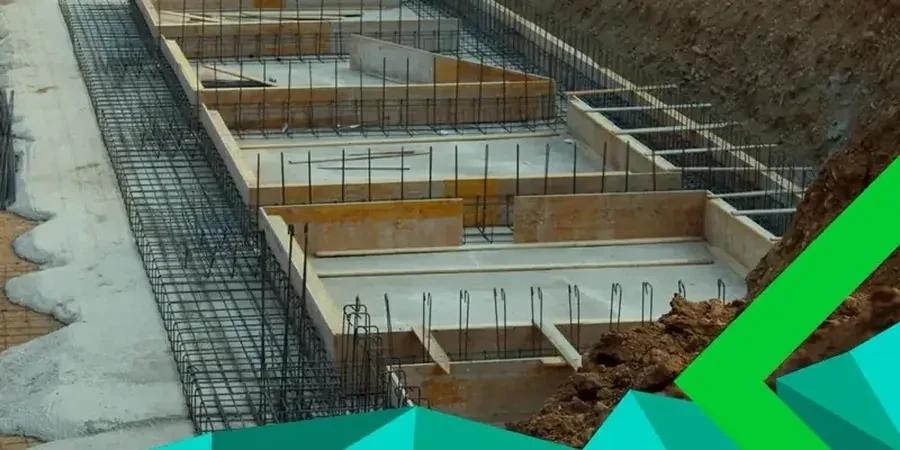
Critical ground factors in Newcastle
A six-storey residential block on a brownfield plot near the Ouseburn Valley taught us a hard lesson about buried obstructions. The initial site investigation missed a 3-metre-wide Victorian culvert backfilled with loose ash and brick rubble, discovered only when the excavator broke through at footing formation level. The original pad foundation design assumed uniform stiff clay — instead we faced a compressible zone directly beneath two column positions. The fix required localised over-excavation and replacement with engineered granular fill compacted to 95% relative density, verified by nuclear density gauge testing. This is not uncommon in Newcastle, where centuries of industrial use have left the subsurface riddled with uncharted voids, old foundations, and heterogeneous fill. A desk study alone rarely captures the full picture; intrusive investigation and experienced interpretation are non-negotiable.
Our services
We deliver the full design chain for shallow foundations, from initial ground investigation specification through to detailed bearing capacity and settlement calculations. Our approach is shaped by Newcastle's unique geology and the requirements of local authority building control.
Bearing Capacity Verification (ULS)
Analytical and numerical assessment using Brinch Hansen or Vesic methods, calibrated against in-situ test data. We apply the UK National Annex partial factors for Design Approach 1, checking both drained and undrained conditions relevant to Newcastle's low-permeability glacial till.
Settlement Analysis (SLS)
Immediate and consolidation settlement predictions using elastic half-space solutions and 1D compression parameters from oedometer tests. We model layered profiles typical of the Tyne valley, where alluvial lenses within the till can produce differential settlements exceeding 25 mm between closely spaced footings.
Foundation Type Selection Reports
Comparative studies evaluating strip, pad, and raft foundation options for complex sites — particularly where former mine entries or variable fill thickness require trade-off analysis between shallow and deep foundation solutions. Each report includes construction sequence recommendations and earthworks specifications.
Q&A
What ground investigation data is needed for a shallow foundation design in Newcastle?
At minimum, you need borehole logs with SPT N-values or CPT profiles to refusal, laboratory classification tests (Atterberg limits, particle size distribution), and groundwater monitoring over at least one season. For sites within the Coal Authority's defined high-risk zones, a mine entry investigation is also required. BS 5930:2015 specifies investigation point spacing — typically 20–30 metre grids for low-rise structures, tightened around known anomalies.
How much does a shallow foundation design package cost for a Newcastle project?
For a typical single-dwelling extension or small commercial unit, our design package ranges from £1,290 to £2,660 depending on site complexity, number of load cases, and whether additional slope stability or groundwater assessments are needed. This includes the geotechnical design report, bearing capacity calculations, and settlement predictions suitable for building control submission.
Can you design shallow foundations on the boulder clay that covers most of Newcastle?
Yes, boulder clay — a stiff, overconsolidated glacial till — is generally excellent founding material. The key risks are its variability: lenses of sand and silt within the clay matrix can act as local drainage paths, and weathered zones near the surface may be softer than expected. We verify stiffness through CPT or SPT data and apply a minimum embedment depth of 0.45 metres to avoid seasonal moisture fluctuation effects.
What is the typical allowable bearing pressure for strip footings in Newcastle?
Prescriptive allowable bearing pressures range from 100 to 250 kPa for strip footings founded on competent glacial till, but these values must be verified by site-specific investigation. Where weathered mudstone is encountered at shallow depth, higher values may be justified. Our designs derive bearing capacity from measured shear strength parameters, not generic tables, ensuring compliance with BS EN 1997-1 requirements for the UK National Annex.