Newcastle’s layers tell a story of heavy industry and Victorian ambition, where the geology beneath our feet varies from dense glacial till to river terrace gravels along the Tyne. When we prepare ground for new infrastructure on sites like the Stephenson Quarter or the expanding residential belts around Gosforth, achieving proper compaction is the difference between a pavement that lasts decades and one that fails after two winters. In our knowledge across the North East, the Proctor test remains the most practical starting point for any earthworks specification. It gives us a clear compaction target—a number that ties directly to on-site density checks. We often pair these lab results with field methods like the sand cone density test to verify that what we specified in the lab actually gets achieved under the roller, because the boulder clay common around Newcastle behaves quite differently once it’s exposed to our persistent drizzle.
Compaction isn't just about density numbers—it's about understanding how Newcastle's glacial tills react to water, and hitting that narrow moisture window before the weather turns.
Scope of work in Newcastle
Critical ground factors in Newcastle
One thing we’ve learned from projects along the Tyne Valley is that reusing site-won fill without a current Proctor reference is a gamble. The same glacial till that looked perfect in the trial pit can lose half its strength if it’s compacted too wet, especially in November when the water table creeps up. We’ve seen car parks in Newcastle develop settlement bowls within eighteen months simply because the fill was placed at moisture contents above the optimum, trapping pore pressures that never fully dissipated. The standard Proctor curve also tells you where the material sits on the dry side of optimum—useful for predicting collapse potential in deeper fills. If the specification requires modified effort and the lab runs only a standard test, the contractor ends up chasing a density that’s physically impossible to reach, leading to unnecessary re-rolling, crushed aggregate, and lost days. Getting the right test from the start avoids those site arguments.
Our services
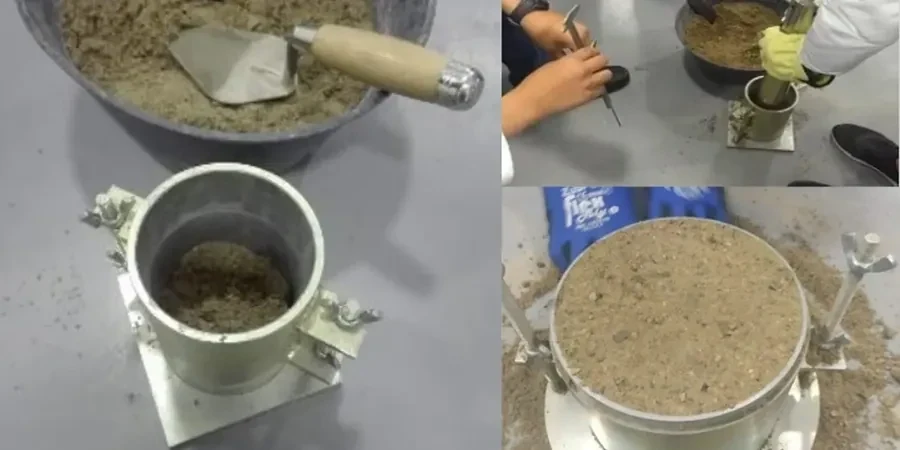
Our Newcastle laboratory provides the full range of compaction testing activities to support earthworks, road construction, and foundation preparation across the region. Every test is run in our UKAS-accredited facility, and we report results within standard turnaround times agreed at project kick-off.
Standard Proctor (BS Light)
Determines the MDD and OMC using 2.5 kg rammer effort, suitable for general earthworks, landscaping, and low-traffic pavement subgrades in Newcastle's residential developments.
Modified Proctor (BS Heavy)
Applies 4.5 kg rammer effort for high-performance applications including motorway embankments, heavy-duty industrial yards, and runway shoulders where higher compaction energy is specified.
CBR After Proctor Compaction
We compact samples at OMC and soak them for four days to determine the California Bearing Ratio, essential for flexible pavement design per the Design Manual for Roads and Bridges (DMRB).
One-Point Proctor Checks
Rapid field support when the borrow source changes mid-shift. We run a single-point verification against the established family of curves to confirm that the fill still meets the specification before placement continues.
Q&A
What does a Proctor test cost in Newcastle?
For standard or modified Proctor compaction tests in our Newcastle lab, you'll typically pay between £80 and £160 per sample, depending on the soil type and whether a rock correction or CBR follow-up is needed. We quote per job for larger earthworks campaigns.
When should I use the modified Proctor instead of the standard one?
Use the modified Proctor when the specification calls for heavy compaction, such as for heavily trafficked roads, airfields, or deep structural fills. The 4.5 kg rammer and greater number of blows simulate the energy of modern vibratory rollers, giving a higher maximum dry density and lower optimum moisture content than the standard test.
How long does it take to get a Proctor test result back?
A standard Proctor curve typically takes two to three working days from sample receipt. The process involves incremental moisture conditioning, compaction, weighing, and oven-drying each point. We can expedite to next-day reporting for ongoing earthworks where the contractor needs immediate density targets.