Between the firm sandstone ridges of Jesmond and the soft alluvial clays along the Ouseburn valley, Newcastle’s ground conditions can switch within a single project boundary. A developer working near the Quayside deals with buried river terraces and historic fill, while someone on the Great North Road might be sitting directly on Pennine Coal Measures bedrock. Stone column design bridges that gap—it transforms compressible or variable ground into a reliable foundation medium without the need for deep piling or bulk excavation. When the site investigation reveals layers of soft silts or loose sands, a properly designed column grid, executed to BS EN 1997, provides a predictable load-transfer mechanism that can cut settlement by half or more. We routinely combine this with CPT testing on Tyne-side sites to map the precise depth of competent bearing strata before finalising the column layout.
A well-designed stone column grid can halve foundation settlement on Newcastle’s alluvial soils, turning a marginal plot into a buildable asset.
Scope of work in Newcastle
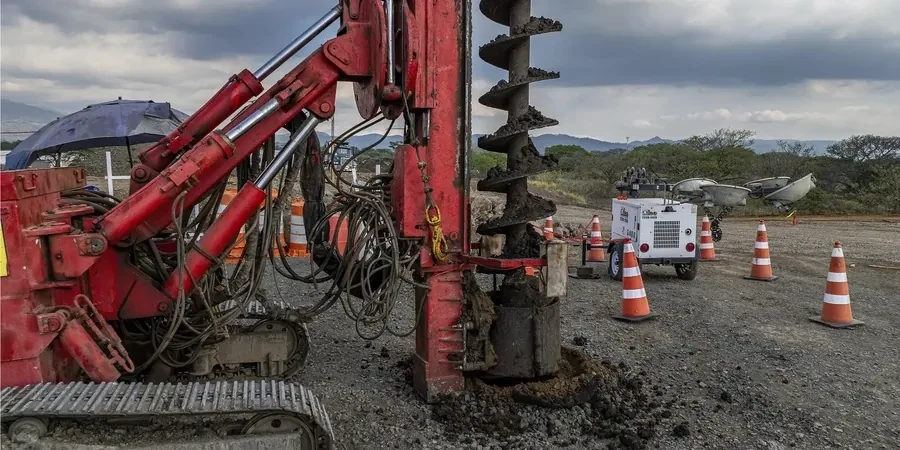
Critical ground factors in Newcastle
BS 5930 and Eurocode 7 require a ground investigation that characterises the full depth of the compressible layer before stone column design begins. In Newcastle, missing a pocket of buried organic clay or an uncharted mine working can lead to differential settlement that appears within months of handover. River-derived alluvium along the Tyne corridor often contains lenses of peat or soft laminated clay that compress unevenly under load. A design that relies on generic SPT N-values without accounting for local variability is asking for trouble. We mitigate this by tying the column grid to a site-specific modulus profile, typically derived from CPTu or pressuremeter tests, so the spacing and diameter match the actual stiffness of each horizon. The investment in a thorough pre-design investigation is small compared to the cost of remedial underpinning once a slab has cracked.
Our services
Our Newcastle stone column design service covers the full workflow from feasibility to construction verification, always calibrated to the city’s ground conditions.
Feasibility and preliminary design
We assess borehole and CPT data from your site investigation to confirm whether stone columns are technically viable, then produce a preliminary layout with estimated settlement reduction factors and a Class 2 cost envelope.
Detailed design package
The package includes column diameter, spacing, depth, area replacement ratio, and load-settlement curves calculated using the Priebe method or 3D PLAXIS analysis where complex loading exists.
Construction verification testing
We specify and interpret post-installation zone load tests, plate bearing tests, or CPT checks between columns to confirm that the installed columns meet the design modulus and that densification has occurred as predicted.
Q&A
How much does a stone column design for a Newcastle residential plot typically cost?
For a standard residential plot requiring a column grid to support strip footings or a light slab, the design fee generally falls between £1,190 and £3,660, depending on the complexity of the ground profile and the number of verification tests specified. A site with multiple soft layers or proximity to the river will push the fee toward the upper end because it demands more detailed analysis.
What soil types in Newcastle are best suited to stone columns?
Stone columns perform well in the soft alluvial silts and clays found along the Tyne and Ouseburn corridors, in loose made ground overlying former industrial yards, and in granular fills that need densification. They are less suitable in very sensitive clays with undrained shear strength below 15 kPa, which occasionally appear in backfilled valley sites.
Do stone columns eliminate the need for deep foundations entirely?
In many cases yes, but not always. On a Newcastle site with 6 metres of soft alluvium overlying competent glacial till, a stone column grid can support a ground-bearing slab and eliminate driven piles. Where the compressible layer exceeds 12 metres or columnar confinement is poor, we may recommend a hybrid solution such as a load-transfer platform over columns or a switch to piled foundations.
How do you verify that the installed columns actually work?
We specify a combination of zone load tests on a sacrificial column and post-installation CPT or plate bearing tests between columns. The acceptance criteria are tied to the design modulus, not just to a generic column density. In Newcastle’s variable alluvium we typically test at least one location per 300 square metres of treatment area.