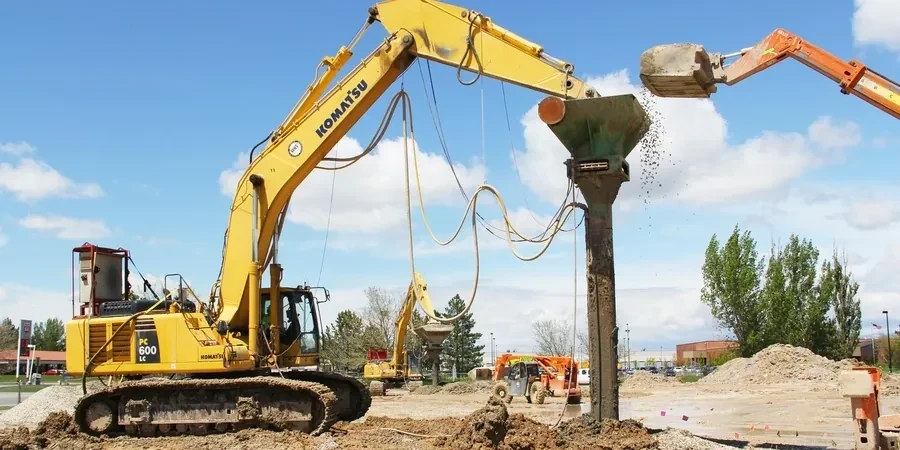
When a deep-reaching electric or hydraulic vibrator penetrates the loose fill and river terrace deposits common across Newcastle, the surrounding granular matrix rearranges itself into a denser state, reducing void ratio within minutes. Our team specifies vibrator power, spacing, and penetration depth based on the city's post-glacial geology—where the River Tyne has left thick sequences of alluvial sands and gravels that can settle unpredictably under structural load. The design brief integrates in-situ pre-treatment data from CPT testing to map relative density profiles and identify layers requiring staged compaction, ensuring the Improvement targets are achievable within the site’s access and environmental constraints. For brownfield sites near the Quayside, we often couple vibrocompaction with stone column installation where silty pockets would otherwise resist densification, giving the contractor a single-source ground treatment package tailored to Newcastle’s post-industrial subsurface.
In the Tyne’s alluvial corridor, a properly designed vibrocompaction grid can raise relative density from below 40% to over 70% in two passes, eliminating deep foundation alternatives.
Scope of work in Newcastle
- Grid geometry and phase sequencing to avoid pore-pressure build-up in confined sand lenses
- Power input per metre of penetration, benchmarked against local case histories from the Team Valley
- Acceptance criteria expressed as minimum relative density or cone resistance, referenced to BS EN 1997-2
- Monitoring protocol with real-time data logging of depth, amperage, and vibration duration
- Integration with pre-existing retaining wall foundations where compaction must not induce lateral displacement
Critical ground factors in Newcastle
BS EN 1997-1 requires that the design of any Improvement scheme demonstrates both ultimate and serviceability limit states are satisfied, a requirement that carries special weight in Newcastle because many regeneration plots sit directly above old mine workings and backfilled docks. Undetected voids or collapsed culverts within the treatment zone can swallow compaction energy, producing a false sense of densification while leaving soft spots that later manifest as differential settlement under slab-on-grade floors. We therefore mandate a desk-study review of Coal Authority records and historical Tyne Improvement Commission maps before finalising the compaction grid, and we design a verification programme that includes at least one CPT per 100 m² in high-risk sectors. Another risk specific to the city’s Victorian-era infrastructure is vibration-induced settlement of adjacent masonry sewers; our specification limits peak particle velocity at the nearest asset and prescribes a trial zone with pre- and post-survey levelling to calibrate safe working distances.
Our services
Our Newcastle-focused vibrocompaction design package includes the following deliverables, each aligned with the ground conditions encountered in the city's river corridor and former industrial districts.
Treatment Design and Grid Specification
We produce a full vibrocompaction layout with penetration depths, energy input per point, extraction rate, and phase sequencing, backed by cross-hole shear-wave velocity targets for the Newcastle soil profile.
Post-Treatment Verification Planning
Design of the verification programme using CPT and SPT arrays, including acceptance envelopes linked to settlement tolerances of the proposed structure, with reporting compliant with BS EN 1997-2.
Vibration Impact Assessment and Monitoring Protocol
For sites adjacent to listed structures—such as those in the Grainger Town conservation area—we deliver a vibration assessment with threshold PPV values and real-time monitoring specifications.
Q&A
How much does vibrocompaction design cost for a typical Newcastle residential plot?
For a standalone residential parcel up to about 400 m², design fees generally fall between £1.170 and £2.350 depending on the complexity of the ground model and the number of verification points required. Larger commercial or industrial sites in Newcastle, where treatment areas exceed 2,000 m² and the Coal Authority review is mandatory, typically range from £2.800 to £4.510. All figures include the design report, grid drawings, and the specification for post-treatment testing.
What soil conditions in Newcastle make vibrocompaction a suitable choice?
The alluvial sands and gravels deposited by the River Tyne and its tributaries are naturally loose below the water table, often registering SPT N-values below 10. Vibrocompaction works well in these granular soils when the fines content (silt and clay) stays under 12–15%. Where the glacial till contains sandier lenses, selective treatment can still be effective, though we typically recommend a pre-production trial to confirm the radius of influence.
Can vibrocompaction be used on Newcastle’s brownfield sites with buried obstructions?
Yes, but only after a careful desk study and intrusive investigation to map obstructions. Many brownfield plots in Newcastle contain old foundations, brick rubble, or backfilled dock structures that can deflect or damage the vibrator. Our design includes a probing grid ahead of compaction and, where obstructions are concentrated, we adjust the layout or recommend a combined approach with stone columns to bridge problematic zones.
How long does the design process take from instruction to issue?
A standard vibrocompaction design for a Newcastle site, assuming the ground investigation data is already available, takes 10 to 14 working days. This includes the interpretation of CPT and borehole logs, development of the treatment grid, vibration assessment, and coordination with the structural engineer on settlement criteria. Expedited programmes can be arranged for urgent enabling works.
What verification testing is required after vibrocompaction in the UK?
BS EN 1997-2 and the ICE Specification for Ground Treatment require post-treatment verification to confirm the design assumptions. In Newcastle we typically specify a combination of CPT soundings at a density of one per 100–150 m², plus a smaller number of SPT or pressuremeter tests for calibration. Surface settlement markers are also installed to monitor residual settlement during the first weeks after treatment, particularly on sites with variable fill thickness.