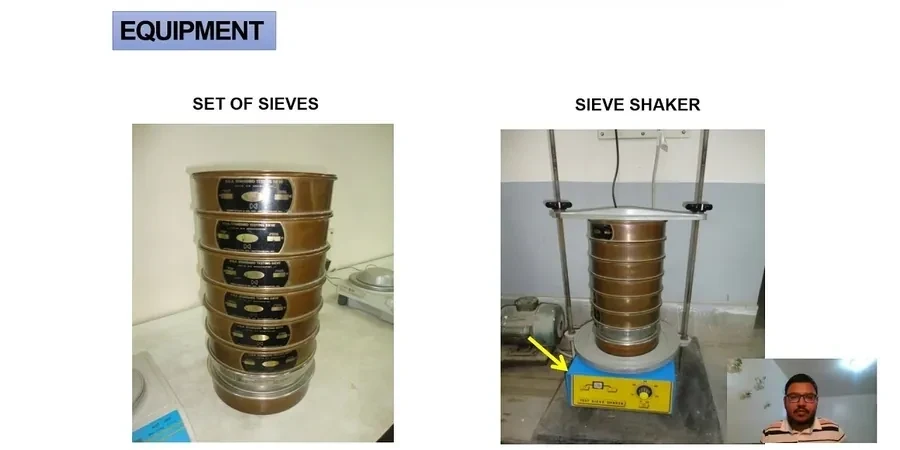
The sieve stack sits on the mechanical shaker—63 mm down to 63 micron brass frames—loaded with oven-dried material straight from a site borehole near the Tyne. In Newcastle we run the full combined method routinely: dry sieving for the coarse fraction, sedimentation hydrometer for the fines passing the 63 µm sieve, all under BS 5930:2015+A1:2020. The local geology demands it. Glacial till, river terrace gravels, and the Coal Measures mudstone weathering profile produce gap-graded soils that a simple sieve-only curve cannot resolve. Our lab on the Team Valley side processes samples within 24 hours of arrival, oven-drying at 105°C ±5°C, weighing to 0.01 g resolution, then plotting the full PSD curve from 63 mm down to 2 µm. For foundation design on the quayside—where the Made Ground can contain everything from ballast to brick fragments—we often pair this with in-situ permeability testing to understand drainage behaviour through the coarse matrix, or with Atterberg limits when the fines fraction exceeds 12% and plasticity becomes the controlling parameter for settlement.
A single PSD curve from a combined sieve-hydrometer test tells you more about a soil's engineering behaviour than a dozen SPT N-values alone.
Scope of work in Newcastle
Procedure video
Critical ground factors in Newcastle
A five-storey residential frame on a brownfield plot off Scotswood Road hit a lens of pulverised fuel ash at 2.5 m depth—fine, uniformly graded, and fully saturated. The contractor assumed a sandy gravel based on the trial pit log; no PSD had been run. When compaction trials failed and the formation heaved under tracked plant, the programme stalled for three weeks. Our combined analysis showed a d10 of 0.008 mm and a uniformity coefficient below 2, meaning the material was highly frost-susceptible and practically undrainable under static load. The solution involved over-excavation and replacement with a well-graded granular fill designed from a target PSD envelope. That single incident—costing the developer nearly £45,000 in delays and remedial earthworks—illustrates why we never skip particle size analysis on Made Ground in Newcastle. The Coal Measures-derived fills across the city are simply too variable: a 200 mm seam of silt can sit directly above opencast backfill, and without a full grading curve you are guessing at the engineering properties. For deeper foundations penetrating into the underlying Pennine Middle Coal Measures, we recommend pairing the PSD with slope stability analysis where basement excavations cut through weathered mudstone horizons that degrade rapidly on exposure to the North Sea air.
Our services
The grain size analysis programme we deliver across Newcastle and the wider Tyne and Wear area covers the full spectrum from site sampling through to interpretive reporting. Each test package is configured to the specific ground conditions encountered on your site—we do not run a one-size-fits-all protocol.
Combined Sieve & Hydrometer Analysis (Full PSD)
Complete particle size distribution from 63 mm down to 2 µm. Includes dry and wet sieving stages, sedimentation hydrometer with temperature correction, and calculation of all gradation parameters (d10, d30, d60, Cu, Cc). Classified to BS 5930 soil description system. Delivered as a graded PSD plot with tabulated results and USCS designation.
Interpretive Report with Earthworks Specification
Beyond the raw data: a geotechnical interpretation of the PSD curve against the intended engineering use. Includes assessment of frost susceptibility, drainage potential (Hazen correlation where applicable), compaction suitability under BS 6031, and recommendations for fill specification envelopes. Particularly relevant for Newcastle brownfield sites where re-use of site-won material is being evaluated.
Q&A
How much does a combined sieve and hydrometer test cost in Newcastle?
For a single sample tested to BS 1377-2 with full PSD reporting, the fee ranges from £80 to £160 depending on the soil type. Coarse gravels requiring larger sample masses and additional wet sieving sit at the upper end; routine fine-grained soils are at the lower end. All prices include the interpretive summary and are quoted ex-VAT.
How long does the hydrometer sedimentation phase actually take?
The hydrometer readings extend over a minimum of 24 hours, with the final reading at 1440 minutes. The full combined test—from sample preparation through to the final plotted PSD curve—takes 3 to 5 working days. We can expedite to 48 hours for an additional surcharge where programme constraints demand it.
Does BS 5930 require a full hydrometer analysis for every sample?
Not necessarily. BS 5930 allows the engineer to specify the test scope based on the material encountered. If the sample contains less than 10% fines by visual assessment, a sieve-only PSD may be sufficient. However, on Newcastle's glacial till and Made Ground sites, we nearly always recommend the combined method because the fines content typically exceeds 12% and controls the soil's behaviour in both compaction and permeability.
Can you run the test on samples we have already taken, or do you need to do the sampling?
We accept disturbed samples collected by others provided they are bagged, labelled, and sealed to preserve natural moisture content where relevant. For hydrometer analysis, a minimum 500 g of material passing the 20 mm sieve is needed. If you prefer us to handle the sampling, our team can mobilise a window sampler rig or cable percussion rig across Newcastle—from the city centre to the Team Valley—usually within 48 hours of instruction.