Designing a retaining wall in Newcastle means confronting ground conditions that rarely appear in textbooks. The city sits atop Carboniferous coal measures, with abandoned mine workings, bell pits, and variable drift deposits blanketing the bedrock. BS EN 1997-1:2004 (Eurocode 7) and the UK National Annex require a ground model that accounts for these legacy features before a single reinforcement bar is sized. Our approach begins with a desk study of Coal Authority records, followed by targeted test pits to expose the near-surface stratigraphy. Where deeper bearing strata are needed, we specify SPT drilling to capture standard penetration resistance in weathered sandstone and glacial till, data that feeds directly into the limit state calculations for sliding, overturning, and bearing capacity.
A retaining wall in Newcastle is a long-term asset, not a temporary works item. The ground investigation budget spent today prevents a failed wall in 15 years.
Scope of work in Newcastle
Critical ground factors in Newcastle
A B27 rotary rig drilling into the coal measures near Scotswood Road tells a story that a desk study alone cannot. The driller watches for sudden drops in flush return, a sign of unrecorded workings or fractured roof strata. If we miss a bell pit beneath the proposed wall alignment, differential settlement can crack the stem and open joints wide enough for fines migration. Newcastle's industrial past layers made ground across much of the city centre and Quayside; this material is heterogeneous, often containing ash, clinker, and demolition rubble. Designing on made ground without verifying its thickness and consistency through investigation is the single largest source of retaining wall failures we encounter. We specify observational method procedures where ground conditions are uncertain, allowing design adjustments during construction if the encountered profile differs from the ground model.
Our services
Our retaining wall design workflow in Newcastle integrates ground investigation, analysis, and detailing into a single deliverable that structural engineers can take directly into construction drawings.
Cantilever & Gravity Wall Design
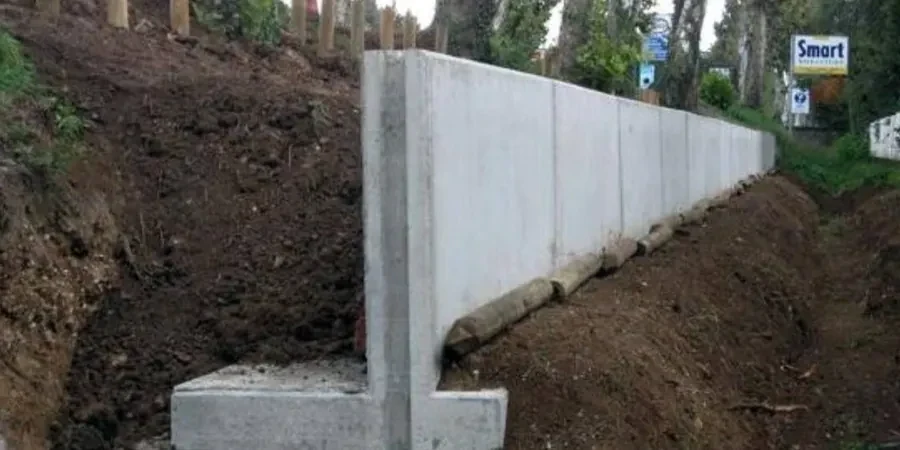
Section sizing and reinforcement detailing for reinforced concrete cantilever walls, mass concrete gravity walls, and masonry gravity structures. Stability checks for sliding, overturning, and bearing capacity under drained and undrained conditions.
Embedded Retaining Wall Analysis
Sheet pile, secant pile, and contiguous pile wall design using limit equilibrium and soil-structure interaction methods. Suitable for basements and deep excavations in Newcastle's urban sites where adjacent structures limit movement tolerance.
Gabion & MSE Wall Specification
Design of mechanically stabilised earth walls and gabion retaining structures for highway embankments, river training works, and landscape terracing. Includes facing specification, reinforcement layout, and drainage detailing.
Q&A
What does retaining wall design typically cost for a residential project in Newcastle?
For a typical residential retaining wall under 2 metres retained height, design fees range from £840 to £1,600 when ground conditions are straightforward. For walls exceeding 3 metres, or where colliery workings and complex ground models are involved, the design package ranges from £2,100 to £3,400, including the ground investigation specification, stability analysis, and reinforcement detailing.
Do I need planning permission for a retaining wall in Newcastle?
In most cases, a retaining wall does not require planning permission if it is under 1 metre in height adjacent to a highway or under 2 metres elsewhere, but Building Regulations approval is typically needed for walls retaining more than 1 metre of ground. The design must demonstrate compliance with Approved Document A, which references Eurocode 7, and we prepare the necessary design certificates for building control submission.
How do you account for old mine workings under a proposed wall alignment?
We start with a Coal Authority mining report and combine it with rotary open-hole drilling to probe for voids. If workings are confirmed within the zone of influence, we design the wall foundation to span or bypass the void, or specify grouting treatment. The design includes a mining subsidence assessment so the wall can accommodate residual ground movement without structural failure.