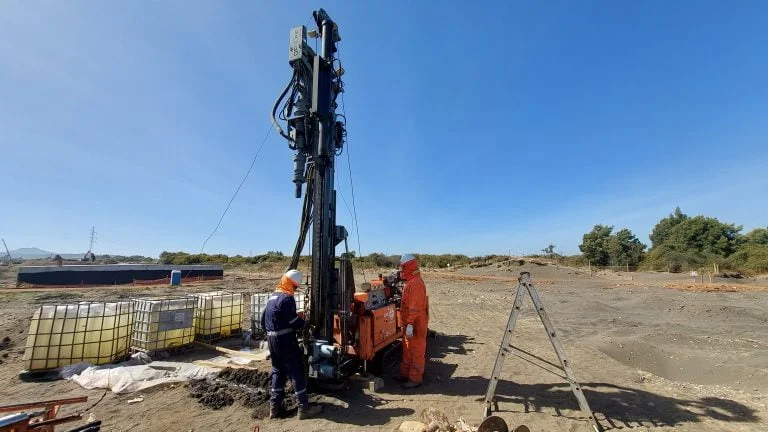
A common mistake on Newcastle’s sloping sites is assuming borehole data alone captures the full variability of the glacial till. The complex drift geology across the Tyne Valley—where laminated clays sit abruptly against sand and gravel lenses—means a single SPT profile can miss critical lateral changes. An exploratory test pit delivers continuous exposure of the near-surface strata, allowing the engineering geologist to log facies changes directly on the excavation face. This approach proves indispensable on former industrial land in Scotswood and along the Ouseburn corridor, where made ground thickness can vary from 0.5 to over 4 metres within a single building footprint. For deeper verification we combine test pit logs with spt-drilling to extend the stratigraphic model into the underlying bedrock, typically the Pennine Middle Coal Measures. The BGS mapping of the area confirms the Quaternary sequence is highly heterogeneous; trial pitting remains the most reliable method to map it before foundation design proceeds.
A test pit log is the only geotechnical record where you can trace a lithological boundary with your finger across the entire excavation face.
Scope of work in Newcastle
Procedure video
Critical ground factors in Newcastle
BS EN 1997-2 places explicit responsibility on the designer to identify ground variability—a requirement that carries particular weight in Newcastle due to the legacy of unrecorded mine workings and backfilled quarries. A borehole-only investigation can miss a 3-metre-deep bell pit directly beneath a proposed pad footing, an occurrence documented by the Coal Authority in the Walker and Byker districts. The exploratory test pit exposes these features in plan view, revealing the true shape, infill material, and extent of old workings. Overlooking this step can result in differential settlement exceeding tolerable limits, triggering structural cracking in masonry terrace blocks that dominate the city’s residential fabric. The Health and Safety Executive’s guidance on temporary works (GS5) further requires a competent person to assess excavation stability throughout the operation, a role our site geologist fulfills on every project from Gosforth to Elswick.
Our services
Our exploratory test pit programme in Newcastle is structured around the specific ground conditions of the Tyne and Wear basin. Each investigation scope is tailored to the site’s geological setting, from the Pennine Coal Measures to the Quaternary drift.
Trial Pitting with Full BS 5930 Logging
Machine-dug pits to 4.5 m depth with continuous geotechnical logging of strata, in-situ density by sand replacement, block sampling of cohesive soils, and photographic documentation of each excavation face. Designed for foundation verification and made ground characterisation across Tyneside.
Reinstatement and Compaction Verification
Controlled backfill placement in 250 mm lifts with nuclear densometer or sand-cone verification to achieve 95% of maximum dry density, ensuring the reinstated ground matches the pre-excavation bearing characteristics for subsequent construction phases.
Q&A
What does an exploratory test pit investigation in Newcastle typically cost?
For a standard programme of two to three trial pits to 3.5–4.0 m depth with BS 5930 logging, in-situ density testing, and full reinstatement, the cost in the Newcastle area generally ranges from £420 to £600 per pit, depending on access constraints, made ground thickness, and the number of samples required for laboratory testing.
How do you manage groundwater inflow during test pit excavation in Newcastle?
In areas like the Team Valley where perched water tables are common within the glacial sand layers, we use a combination of sump pumping from a low corner of the excavation and, where necessary, well-point dewatering installed one day ahead of the dig. The pump discharge is routed to existing surface water drains under an environmental permit, with silt filtration to prevent sediment entry.
What licensing or permitting is required for trial pits in Newcastle upon Tyne?
A permit to excavate in the public highway from Newcastle City Council is mandatory for any pit within the adopted road network. On private land, we submit a Ground Investigation Method Statement to the local building control authority and, for sites within the Coal Authority reporting area, a mining risk assessment and permit to break ground may be required before excavation proceeds.